I grew up reading a lot of historical fiction. From the age of about ten, I devoured novels by Jean Plaidy, Margaret Irwin and Margaret Campbell Barnes, and particularly enjoyed their books about Henry VIII. I had an especial fondness for Jean Plaidy’s Murder Most Royal and Brief Gaudy Hour by Margaret Campbell Barnes. Both books were about the rise and fall of Anne Boleyn and both featured a villain – Thomas Cromwell – who tortured musicians and brought down queens. My early ventures into reading Tudor fiction meant that I always thought of Cromwell as a Very Bad Man.
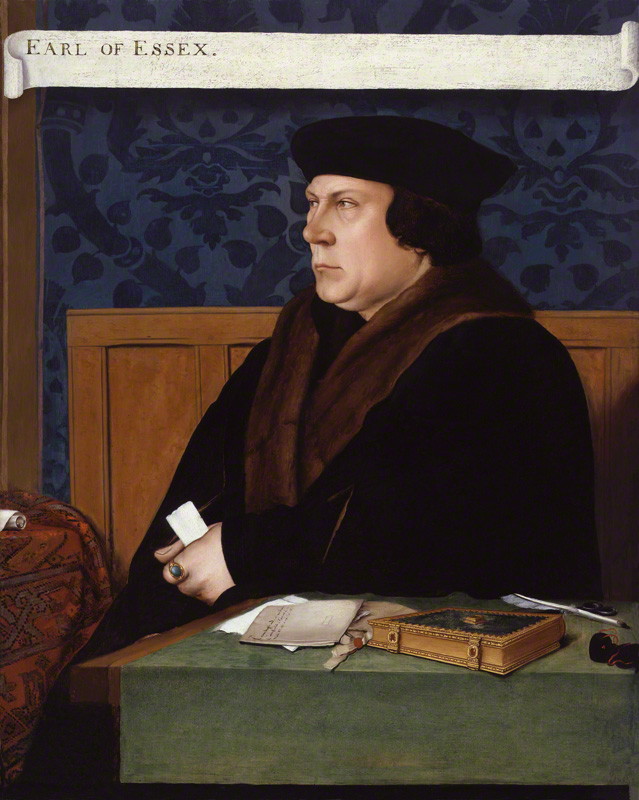
NPG 1727; Thomas Cromwell, Earl of Essex after Hans Holbein the Younger. © National Portrait Gallery, London. *
But in April 2009, a new book was published and this book changed my viewpoint completely. This book featured Thomas Cromwell as its central character: Hilary Mantel’s magnificent Wolf Hall. As Mantel’s hero (or should that be anti-hero?), Cromwell is witty, charismatic and slippery, loyal to his friends and ruthless to those who cross him. A devoted family man. A patron saint for administrators, archivists and minute writers. And a man who knows about cloth.
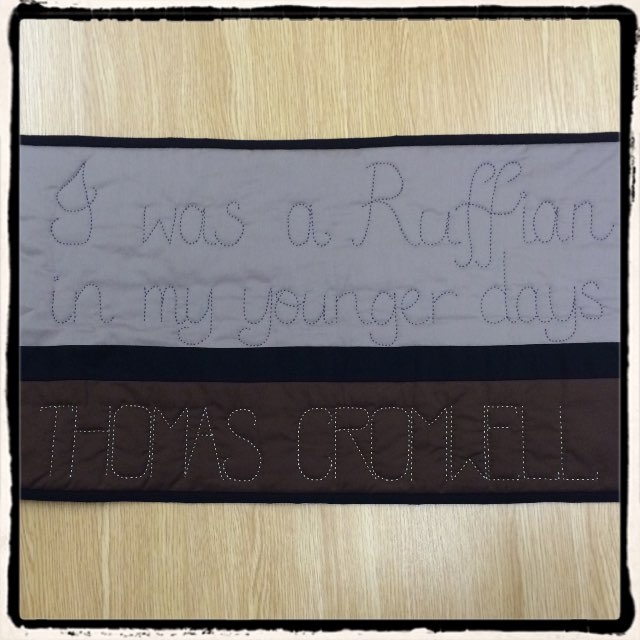
The Thomas Cromwell Quilt
Re-reading Wolf Hall recently, I was struck by the number of references to textiles, and how beautifully they are described by Mantel. Velvets, brocades, silks, wool, sables, satins all burst from the page.
As a youth fleeing England, young Thomas Cromwell meets “three elderly Lowlanders”, traders in cloth, who show him their “woollen samples and discuss among themselves the weight and the weave.” Cromwell learns about cloth and concludes that “with wool so long in the fleece these days, and good broadcloth hard to weave, he ought to be getting into kerseys, lighter cloth like that, exporting through Antwerp to Italy.” He understands what clothes of the right fabric can do; on meeting the poor but beautiful Helen, “mentally, he takes her out of cheap shrunken wool and re-dresses her in some figured velvet he saw yesterday, six shillings the yard.”
As Cardinal Wolsey’s man, Cromwell admires a tapestry of “the woollen monarchs,” Solomon and Sheba: a tapestry that depicts a woman he has known and that weaves its way throughout the book. When Wolsey falls, Cromwell watches the cardinal’s finery being packed away: “bolts of fine holland, velvets and grosgrain, sarcenet and taffeta, scarlet by the yard.” Cromwell knows its value. “In public the cardinal wears red, just red, but in various weights, various weaves, various degrees of pigment and dye, but all of them the best of their kind, the best reds to be got for money. There have been days when, swaggering out, he would say, ‘Right, Master Cromwell, price me by the yard!'” And in a spirit of thrift that will be appreciated by patchworkers everywhere, this fabric has a second life after Wolsey’s death: “The cardinal’s scarlet clothes now lie folded and empty. They cannot be wasted. They will be cut up and become other garments. Who knows where they will get to over the years? Your eye will be taken by a crimson cushion or a patch of red on a banner or ensign. You will see a glimpse of them in a man’s inner sleeve or in the flash of a whore’s petticoat.”

Sewing the binding.
Cromwell’s wife, Liz, does “a bit of silk-work” and complains about “the price of thread.” Their sheets are of fine linen and they sleep “under a quilt of yellow turkey satin.” In one of my favourite scenes, Liz embroiders shirts for their son Gregory “with a black-work design; it’s the same one the queen uses, for she makes the king’s shirts herself. ‘If I were Katherine I’d leave the needle in them,’ he says.” In this world, sewing is a weapon. Does Anne Boleyn pull the stitches out of her sister’s embroidery? How can his niece’s “awkward little backstitch” be used to protect Cromwell’s letters? Will a book of needlework patterns wrapped in kingfisher blue silk be taken from Jane Seymour? Who will unpick embroidered pomegranates, representing the badge of Katherine of Aragon?
As readers may have guessed, I know the text of Wolf Hall very well. It’s my favourite book, and as well as reading from the page, I find the excellent unabridged audiobook, read by Simon Slater, the perfect sewing accompaniment. And in 2014, my enjoyment was enhanced even further by the magical stage adaptations of Wolf Hall and its sequel, Bring Up the Bodies, developed by the Royal Shakespeare Company and Playful Productions.

Wolf Hall and Bring Up the Bodies at the Aldwych Theatre
I was lucky enough to see the plays in both Stratford-upon-Avon and London, and was so swept away by them that I simply had to sew something. Mantel’s Notes on Characters, written for the plays, say of Cromwell: “You don’t say much about your past, but you tell Thomas Cranmer, ‘I was a ruffian in my youth.’ Whatever this statement reveals or conceals, you have a lifelong sympathy with young men who have veered off-course.” I love that sentiment – and it formed the basis for a little quilt tribute to Thomas Cromwell, Hilary Mantel, Mike Poulton, and the cast, musicians, production team and backstage crew of the plays that I enjoyed so much.
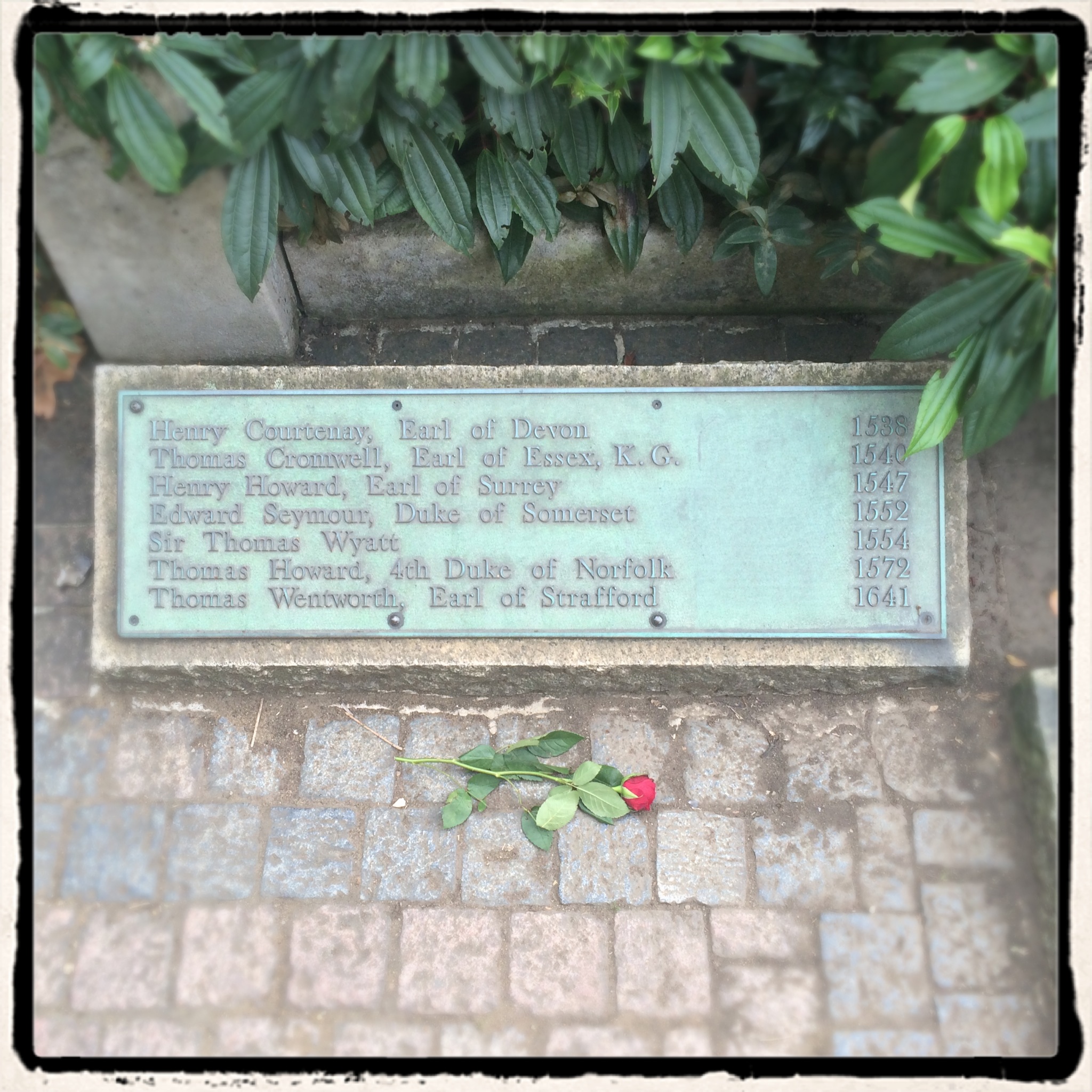
Memorial plaque at Tower Green
* The image of Thomas Cromwell from the National Portrait Gallery, London is used under the terms of the Creative Commons license.

 is there room for me to sew?